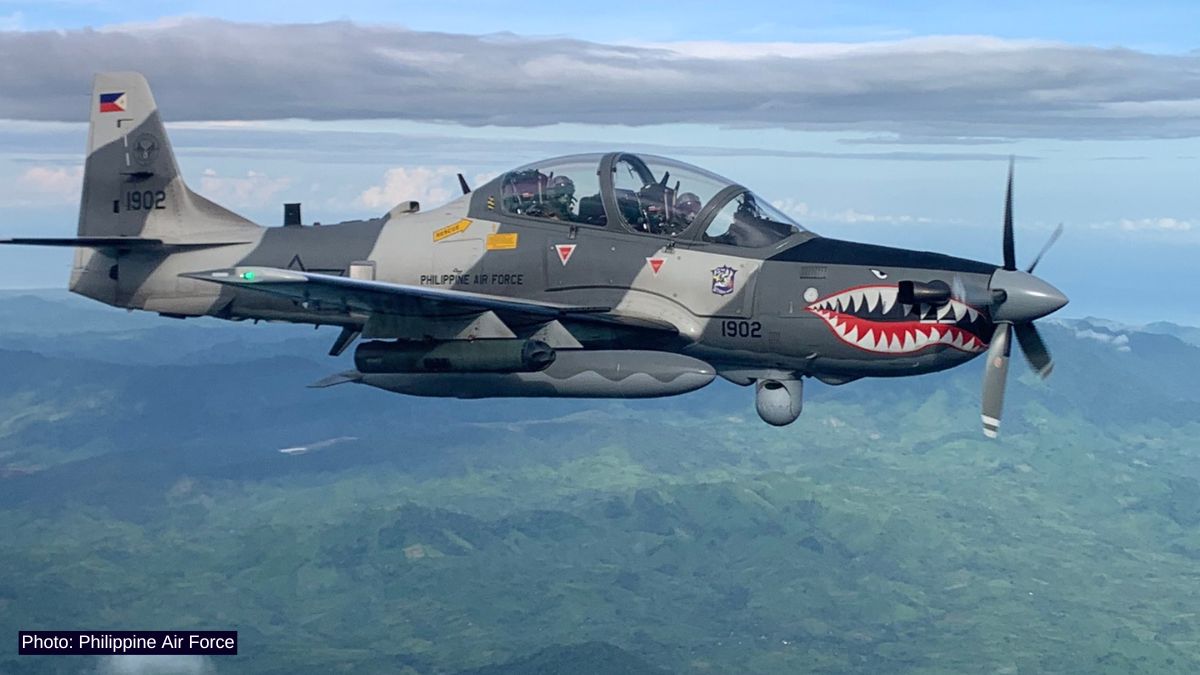
Social media spreads many wrong labels about some aircraft. One label I often hear in the Philippines is that the Embraer A-29B Super Tucano is “Tora-Tora” or vintage because it has a propeller. That idea is wrong. A propeller does not decide if an aircraft is modern. The mission, sensors, avionics, and weapons decide that.
“Tora! Tora! Tora!” is linked to the Pearl Harbor attack in 1941. It was used as a code signal during that operation. People later used “Tora-Tora” to describe World War II-era prop fighters, especially the Mitsubishi A6M Zero. The A-29B is not a World War II fighter. It is a modern combat aircraft designed for today’s counterinsurgency and close air support missions.
The A-29B is a turboprop, not a piston engine warbird. A turboprop uses a gas turbine engine core, then uses that power to turn a propeller. The gas turbine is the same basic engine type used in jets. The propeller is used because it is efficient at lower speeds and lower altitudes, which is where this aircraft does most of its work.
The A-29B was designed for COIN and CAS. COIN means counterinsurgency. These missions focus on finding and stopping insurgent groups, often in remote areas, with long patrol time and careful target identification to avoid mistakes. CAS means close air support. This is when an aircraft attacks targets near friendly ground forces, so accuracy and coordination matter because friendly troops are close. Both COIN and CAS often need an aircraft that can fly low and slow, stay over the area for hours, and operate from smaller airfields closer to the fight.

The Super Tucano is a modern aircraft
The A-29B is modern because it was built as a complete combat system. The cockpit uses modern displays and mission computers that help the pilot manage navigation, communications, sensors, and weapons. The aircraft supports night vision goggle operations, which matters in real missions where targets and threats do not appear only in daylight. The aircraft also supports secure communications and coordination with ground units and command centers.
A key part of its capability is the EO/IR sensor. EO/IR means electro-optical and infrared. Electro-optical is a high-quality camera for daytime viewing. Infrared is a heat sensor that helps detect people, vehicles, and activity at night or through haze. This system helps the crew spot a target, confirm it, track it, and support accurate weapon use.
Speed is up to 320 knots, which is about 593 km/h. Weapon payload is up to 1,550 kg, which is about 3,400 lb on external stations, plus two internal .50 caliber machine guns. Combat radius varies by fuel tanks and weapons carried, with a light attack mission example showing about 100 to 400 nautical miles, which is roughly 185 to 740 km, paired with different time-on-station options. Minimum runway length under standard conditions is about 900 meters for takeoff and 860 meters for landing. MTOW is 5,400 kg, about 11,900 lb.

Why the Super Tucano is not a “Tora-Tora” plane
A typical World War II “Tora-Tora” fighter used basic radios, simple cockpit instruments, limited navigation, and mostly unguided weapons. The A-29B uses mission computers, modern displays, secure communications, EO/IR targeting, and guided weapon options. The mission is different as well. A6M-era fighters were built mainly for air-to-air combat in a 1940s threat environment. The A-29B was built for surveillance and strike in modern low-altitude conflicts where endurance, coordination with troops, and accurate targeting matter.
Operators include Angola, Brazil, Burkina Faso, Chile, Colombia, the Dominican Republic, Ecuador, Indonesia, Lebanon, Mali, Mauritania, Nigeria, Paraguay, the Philippines, Portugal, Uruguay, and the United States, plus additional customers that are not publicly named in all cases. Some fleets change over time due to upgrades, replacements, and local security needs.

I understand that it is hard to remove the “Tora-Tora” label from how many Filipinos talk about the A-29B. Silence makes the label sound correct, and I do not want that. I will keep explaining the facts clearly because the Super Tucano is not a “Tora-Tora” plane. The Philippine Air Force choice of the A-29B was smart for the missions the country faces. The Philippines deals with insurgency threats and needs an aircraft that can loiter, search carefully, coordinate with troops, and provide close air support in jungle and mountainous areas. The A-29B fits that role well because it can stay on station for long periods, operate from shorter runways, and use modern sensors to support controlled and accurate strikes.
The aircraft is still far from the A-10’s capabilities, yet it remains a capable COIN and CAS platform for the missions the Philippines actually flies.
Post Comment