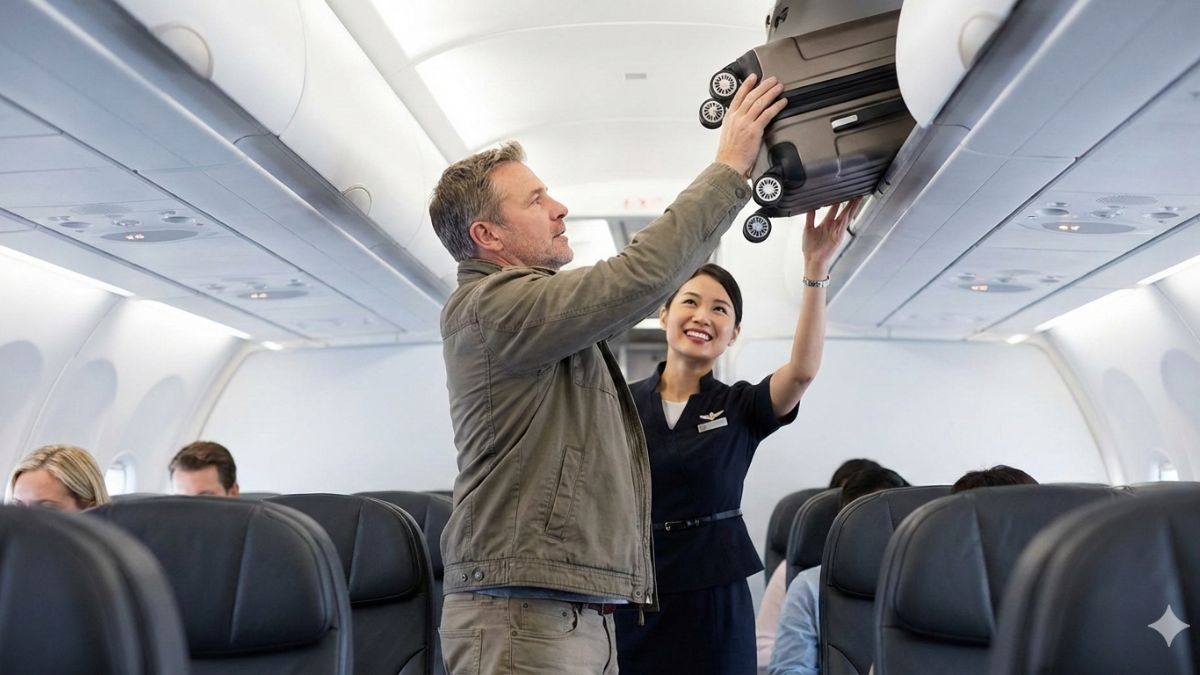
This issue has been around for years, and it keeps coming back because many passengers still think lifting carry-on luggage into the overhead bin is part of a flight attendant’s job. It is not. A flight attendant may help a passenger who truly needs assistance, but that is very different from being expected to keep lifting passenger bags again and again during boarding. The primary job of cabin crew is safety and security. That is exactly why airlines place limits on this kind of lifting.
The basic carry-on rule is simple: the bag must be safely stowed. IATA states that, for safety and operational reasons, carry-on baggage must be stowed under the seat in front of the passenger or in the overhead compartment. FAA rules also require airlines to control the size and amount of carry-on baggage and to make sure it is secured properly before taxi, takeoff, and landing. That is the duty. The rule is about safe storage, not about requiring cabin crew to lift every bag for every passenger.
Some airlines say this very clearly. British Airways states that passengers must be able to lift their cabin bag into the overhead compartment unassisted. Hong Kong Airlines goes even further and states that, as part of its safety regulations, cabin crew are not obligated to carry guests’ baggage, and passengers are required to lift their hand-carry luggage into the overhead compartment. That already tells you where airlines draw the line.
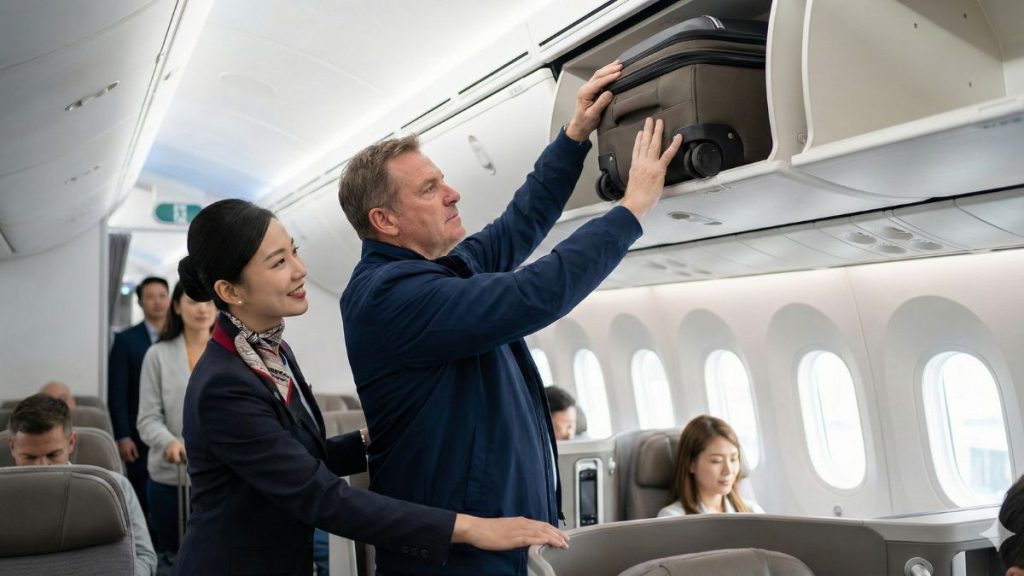
2,000 lifts, 14,000 kg of luggage in one month
The physical strain becomes easy to understand when you look at the numbers. A common carry-on limit is 7 kg. Here’s an example. If a flight attendant were expected to lift one 7 kg bag for every 50 passengers, that would mean 50 lifts in one flight sector. That is a total lifted load of 350 kg in one leg. On a round trip, that becomes 100 lifts, or 700 kg of total lifted load. If that crew member works five round-trip flights in one week, that becomes 500 lifts and 3,500 kg of total lifted load. Over roughly four weeks, that becomes 2,000 lifts and 14,000 kg of total lifted load. That example uses only the 7 kg limit. In real operations, some passengers bring even heavier bags, which pushes the physical strain even higher.
Repeated overhead lifting is not a small issue. Repetitive lifting increases the risk of work-related back, shoulder, and muscle injuries. Overhead bin loading is harder than a normal lift because it is done above shoulder level, often in a narrow aisle, with little room to move properly. The lift is awkward, repeated, and done under time pressure during boarding. That increases the risk even more.
This directly affects safety because flight attendants are primarily hired to respond to emergencies. In a real emergency, a crew member may need to open exits, manage an evacuation, fight a fire, assist an injured passenger, or physically move someone who cannot move on their own. A preventable back or shoulder injury can affect that response. If a crew member gets injured from repeated lifting during boarding, that can weaken the crew’s ability to do the work that actually protects lives.
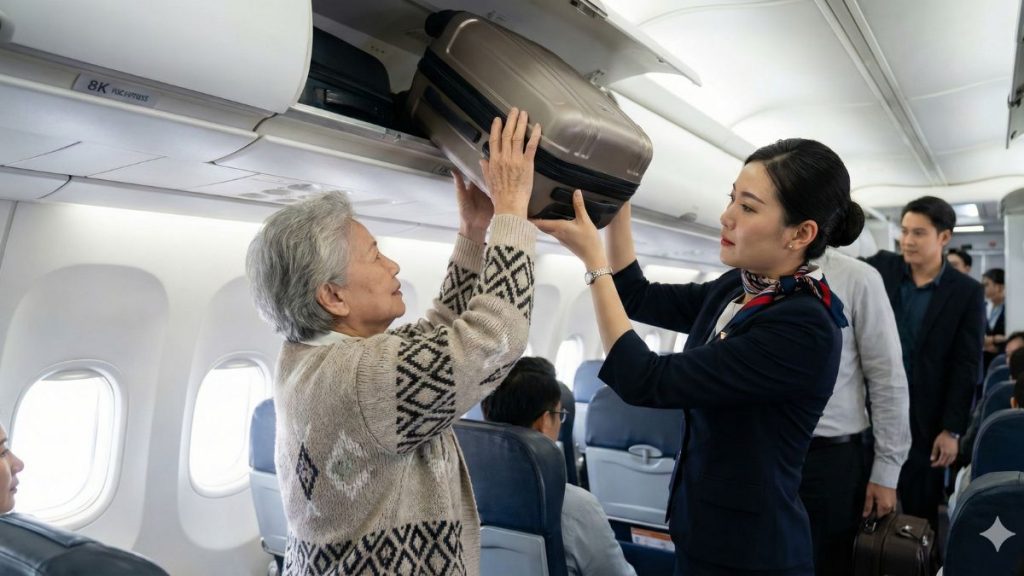
This is why assistance has limits. Flight attendants are encouraged to help passengers who truly need support, such as elderly passengers, pregnant women, passengers with disabilities, injured passengers, or anyone who is physically limited. That is reasonable assistance. That is not the same as making crew members responsible for every able-bodied passenger’s bag. If a bag is too heavy for an able-bodied passenger to lift, then it is also too heavy to expect a flight attendant to keep lifting again and again. In many cases, that bag should be checked instead of brought into the cabin.
Passengers often misunderstand the difference between assistance and responsibility. Assistance means helping when there is a genuine need. Responsibility means the task belongs to you by default. Lifting every carry-on bag does not belong to the flight attendant by default. The passenger is still responsible for bringing a bag that meets the airline’s limits and can be handled safely.
The point is simple. If you are able to carry your bag from home to the car, through the airport, and to the gate, you should also be able to lift it into the overhead bin. Flight attendants are there to keep the cabin safe. They are not there to take on preventable injuries because a passenger does not want to lift their own bag. Protecting the crew’s physical condition helps protect everyone on board, because the crew needs to stay fit enough to do the job they were actually hired to do.



Post Comment