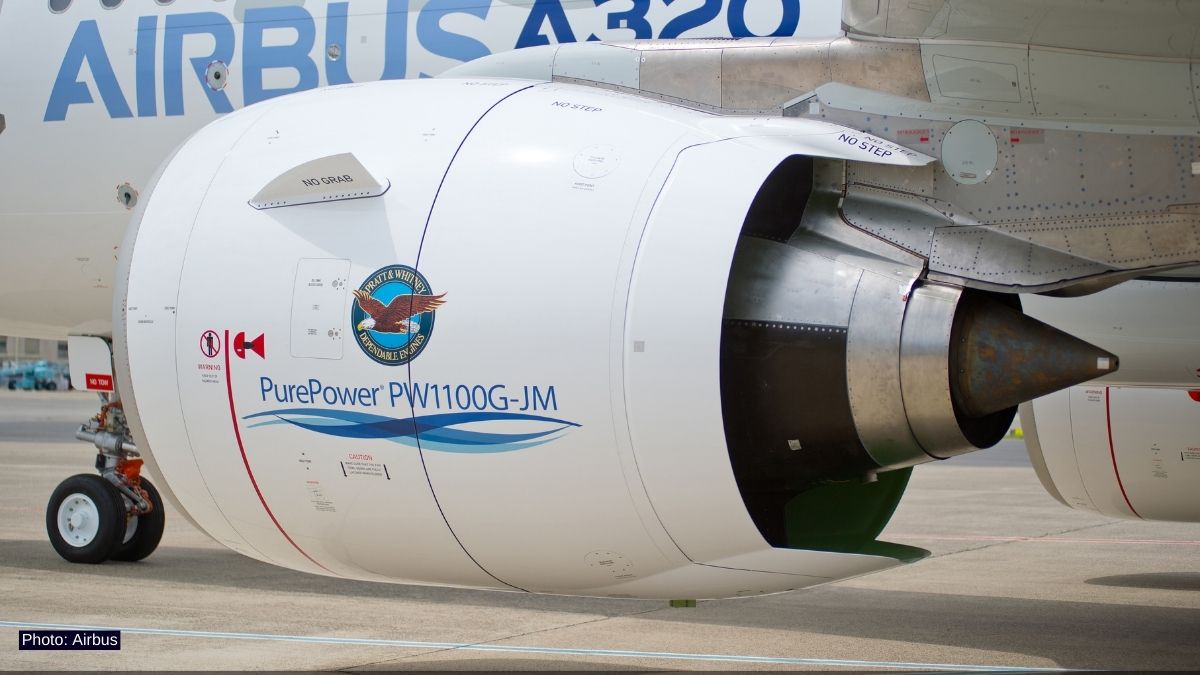
Many people get the impression that geared turbofan engine technology is flawed, mainly because the Pratt & Whitney geared turbofan issues have affected the A320neo family. A closer look at how the geared turbofan works shows why it remains a strong idea. The goal is to cut fuel burn and noise while still giving an aircraft the thrust it needs. New designs can face early durability and inspection challenges, yet I still see this technology as an important part of turbofan engines in the years ahead.
A geared turbofan works like a normal turbofan, with one extra part: a reduction gearbox. The gearbox sits between the large front fan and the low-pressure turbine that drives it. This setup lets the fan and the engine core spin at different speeds, instead of being locked together on one shaft. The fan can run slower, where it moves air more efficiently, and the core can run faster, where it compresses air and extracts power more efficiently.
The fan prefers a lower RPM because its blades are long, and higher RPM pushes the blade tips toward very high speeds. High tip speeds can increase noise and reduce efficiency. The compressors and turbines in the core prefer a higher RPM because the core needs speed to compress air and to extract power from hot gas. A conventional turbofan forces a compromise because the fan and the low-pressure turbine share a shaft and must spin together at the same speed.
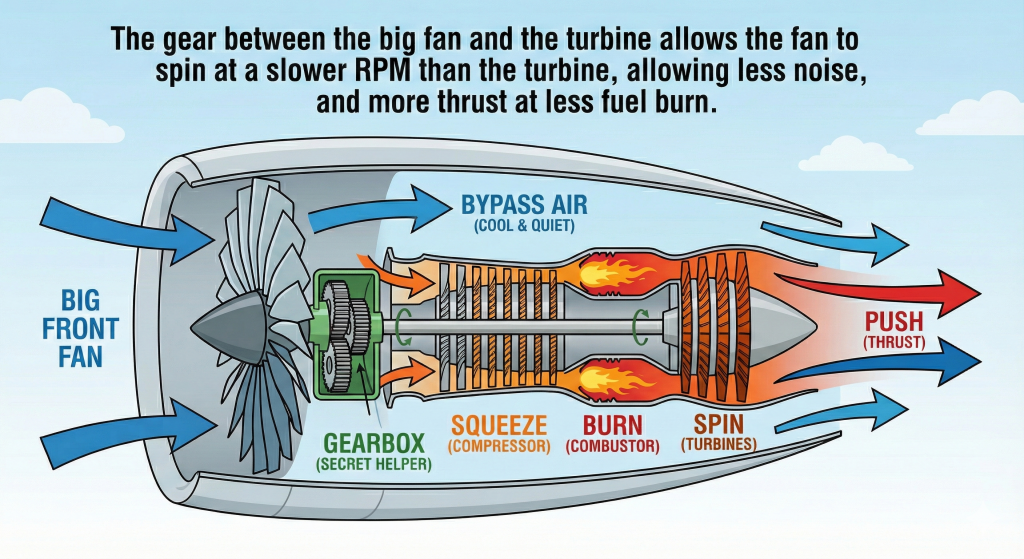
A geared turbofan breaks that compromise. The gearbox reduces the speed that reaches the fan, even as the turbine behind it spins faster. The reduction gearbox allows the fan to rotate more slowly while the low-pressure compressor and turbine run faster at the same time, so components can operate closer to their optimal point. The gearbox simply helps each section operate in a more efficient speed range.
High-bypass engines are efficient because they move a large amount of air and speed it up a little, instead of moving a smaller amount of air and speeding it up a lot. The fan lets a turbofan produce more thrust for nearly the same core fuel burn, which is why high-bypass turbofans are very fuel efficient. A geared layout supports larger fans because the fan can stay at a sensible RPM while the core stays fast where it works best. This helps airlines chase better efficiency without giving up the takeoff and climb performance they still need. This also results to lower engine noise since the fan rotates at lower RPMs.
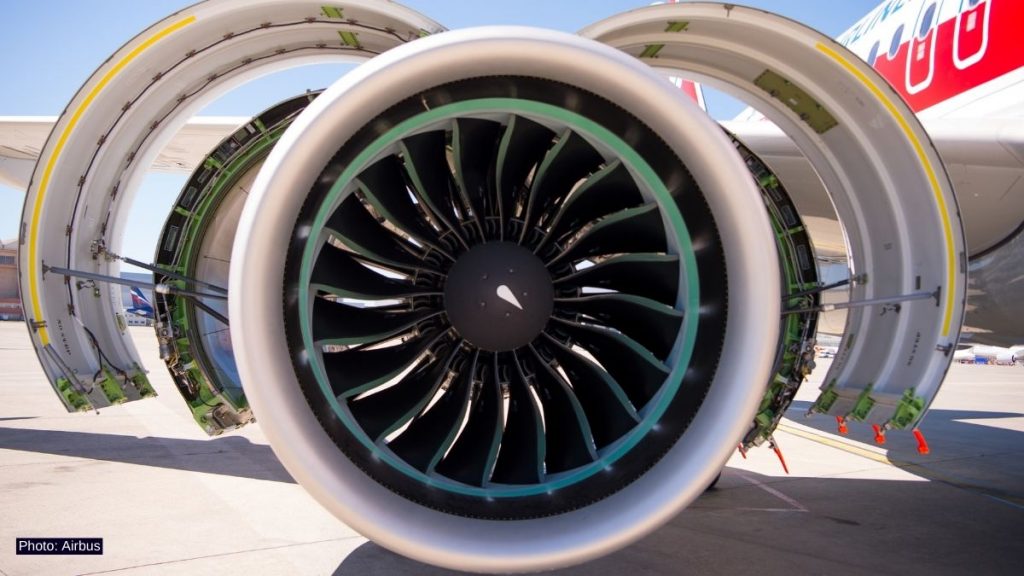
The PW1100G-JM GTF powers the Airbus A320neo family. The PW1500G powers the Airbus A220. The PW1700G and PW1900G power Embraer’s E-Jet E2 family. Pratt & Whitney also developed the PW1400G for the Yakovlev MC-21 program.
Rolls-Royce is also building toward a geared future through its UltraFan technology demonstrator. The UltraFan “Power Gearbox” is designed to let the turbine at the rear run at a very high speed while the fan at the front runs slower. Rolls-Royce announced successful first tests in Derby, UK on May 18, 2023, and it said those tests used 100% sustainable aviation fuel. They later said the demonstrator ran to maximum power on November 13, 2023.
Pratt & Whitney GTF issue
A fair question comes up often: why does the Pratt & Whitney GTF continue, even with durability and inspection challenges? Airlines still want the efficiency and noise benefits. The GTF family targets about 20% lower CO2 emissions versus the previous engine generation and a smaller noise footprint. RTX told investors in September 2023 that powder-metal related inspections would drive higher aircraft-on-ground levels for GTF-powered A320 family aircraft through 2024 to 2026.
Despite the GTF issues, sales still continued. One example is when Cebu Pacific chose Pratt & Whitney engines for 152 A321neo aircraft on order in July 2024. In April 2025, Pratt & Whitney developed an additive manufacturing repair process aimed at cutting repair time by more than 60% for some GTF components, as part of its push to expand repair capacity. This is why I see the geared turbofan as a long-term direction, even while the current fleet works through fixes.



Post Comment